
Metropolitan Playhouse
The American Legacy
The American Legacy
"Theatrical
archaeologist extraordinaire" - - Back Stage

Follow us....


|
Metropolitan Playhouse
The American Legacy "Theatrical
archaeologist extraordinaire" - - Back Stage
|
Follow us.... |
|||||||
| Playing | Next | Season | Tickets | Company | Location | Mission | History | Links |
|
| The Climbers |
 |
|
|
|
ARE WE THERE, YET?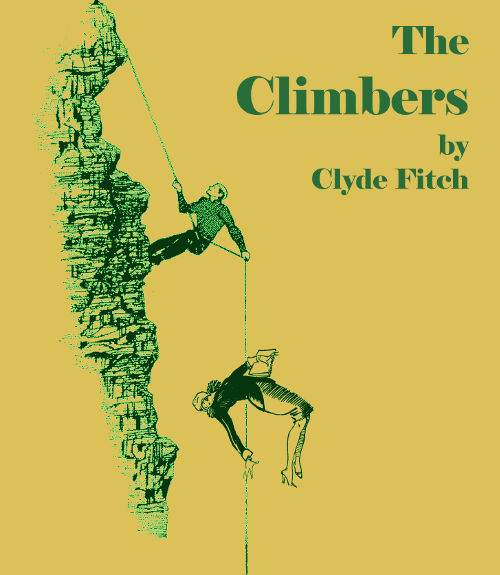 In the land of opportunity, no star is beyond our grasp. No aspiration is too high, if only we will reach for it. But is the invitation to continually strive a gift, or a curse? Is opportunity-worship devotion to a jealous idol? Is it, in fact, a goblin haunting the American dream? Farcical and heartbreaking by turns, Clyde Fitch’s 1901 The Climbers defies easy categorization, but by changing its own tone, this long- overlooked play captures an elusive quarry and an essential conundrum for the American social animal. At the dawn of the 20th century, the altruistic and esteemed head of the Hunter family has died before his time, leaving his wife and three daughters with an unwelcome surprise. Desperate in his final months to keep up with the demands of their extravagant social life, he made a risky investment and lost the family’s once substantial fortune, leaving them with no assets or income at all. If the fires of adversity prove one’s mettle, the various members of this family seem to be made of different stuff. Mr. Hunter’s widow, youngest daughter, and son-in-law scheme to dupe others into making up their losses. Meanwhile, his sister and two elder daughters vow to care for themselves and their families whatever the personal costs. From these different campaigns spring both the wicked comedy and tender pathos of the play. COME-TRAGEDY Fitch’s
parodies of the avaricious and self- absorbed are
unparalleled in their incisive glee, and his funniest
scenes skewer the shallow values of the covetous.
Witness widow Hunter in her efforts to sell newly
acquired Parisian gowns to a pair of lesser
socialites, while simultaneously flaunting her
daughter to a would-be suitor—transactions somewhat
complicated by her need to vie with that daughter for
attention. She is a woman more anxious that her
husband’s funeral be a social success than a fitting
memorial, while her daughter laments that a season of
mourning will rob her of her society debut. Following
the journey of these narcissistic Hunters to its
logical conclusion leads to a love triangle as comical
as it is uncomfortable. At the same time, the author’s tender understanding of misplaced faith and broken hearts lets him appraise his age with compassion as well as mockery. Through the modest determination of one daughter to work to survive, the play gently rebukes the grasping indolence of her younger sister. By finely painting the heartbreak of the eldest daughter, when she discovers the extent of her husband’s self-dealing, the play passes wrenching censure on avarice’s betrayal. And in revealing a long-guarded secret of the girls’ upright aunt, The Climbers plants an unwavering standard to upholding principle over self. With that aunt’s words as an epigram— “the twentieth century is to be a glorification of selfishness, the Era of Egotism!”—the play might be seen as a typical indictment of the Gilded Age and its materialism, selfishness, careless speculation, and eroding values. But The Climbers aims higher than a simple critique of an acquisitive class. The sanctimonious aunt urges her niece to self-sacrifice. “Forget yourself, and what would you do? The dignified thing.” But in an age when another character can observe, “More people get divorced, nowadays, than get married,” striving for dignity seems more than out-of-date; it seems vain. By following comical with pathetic scenes, and by pairing frivolous with philosophical characters, Fitch equates the selfish with the selfless. To obsess over one’s social status is narcissistic and self-serving, but so is to fetishize one’s moral status. To live at pampered leisure is indulgent, but so is to live in ascetic rectitude. NO WAY TO GO, BUT UP In
truth, the Hunters and their circle are climbers, all,
whether their ascents are financial, social,
righteous, or sentimental. In a wittier, gentler way,
the play recalls Nietzsche’s assertion in Beyond Good
and Evil, published four years earlier: neither moral
nor immoral, “life simply is will to power.”1
Climbing, in this light, is not a vice; it is a condition of life in American society. Indeed, whatever its demands, climbing may be what holds society together. To climb, for most of the characters, is to connect with others, which they desperately yearn to do, and the play is plain about the consequence of failing to connect. The self-interested son-in-law, whose energetic reaching repeatedly exceeds his grasp, breaks under the failures of his financial schemes. Acutely aware he has earned a devoted wife’s disdain, unable to bear the charity of constant friends, he swings wildly from spiteful recriminations to clandestine flight, and ultimately alcohol, opiates, and worse. The toll detachment takes on him makes very plain that there is no alternative to staying in the fold, even if that means continuing to climb. Part satire, part tragedy, The Climbers is a feeling portrait of a human quandary, and it ends with questions rather than answers as to the course of its characters’ lives. Prescient at the start of a new century, the play asks what, in an age of crumbling morals, rampant speculation, and ascendant vulgarity, is the way forward for the weak and for the strong, the selfish and the magnanimous, the guarded and the transparent, when they have no choice but band together? Bringing many artists from Metropolitan’s past seasons together for the first time, it is the play to begin the Season of Resilience. -Alex Roe 1 Beyond Good and Evil, trans.
Walter Kaufmann
|
|
| William Clyde Fitch Clyde Fitch (Playwright), between 1890 and 1909, wrote at least 62 plays—36 original scripts, 21 adaptations, and five dramatizations of novels. For most of his career, he was the reigning king of New York theater: on one occasion, he had four plays running on Broadway; on another occasion, he had five. His annual earnings were equivalent to $15 million today. As sensational as his plays were, with their opulent, realistic settings and reliance on well-worn plots and melodrama, controversies also followed the author himself, involving plagiarism (false), obscenity (acquitted), and homosexuality (true). Two of his finest plays (both revived at Metropolitan) raised eyebrows—what with Fitch’s female lead in The Truth committing suicide, and audiences at The City shocked and even fainting over Fitch’s depiction of drug abuse, incest and an actor uttering the word “goddamn” for the first time on a Broadway stage. Off-stage, Fitch raised eyebrows with his sartorial flamboyance, luxurious lifestyle, and, early in his career, a brief romance with Oscar Wilde, to whom he was often compared. Fitch died in France in 1909 at age 44. Read more....The Clyde Fitch Report |
|
 |
 |
|