
Metropolitan Playhouse
The American Legacy
The American Legacy
"Theatrical
archaeologist extraordinaire" - - Back Stage

Follow us....



|
Metropolitan Playhouse
The American Legacy "Theatrical
archaeologist extraordinaire" - - Back Stage
|
Follow us.... |
|||||||
| Playing | Next | A Woman's Honor | Tickets | Company | Location | Mission | History | Links |
|
| The Clod A One-Act Play by Lewis Beach |
| |
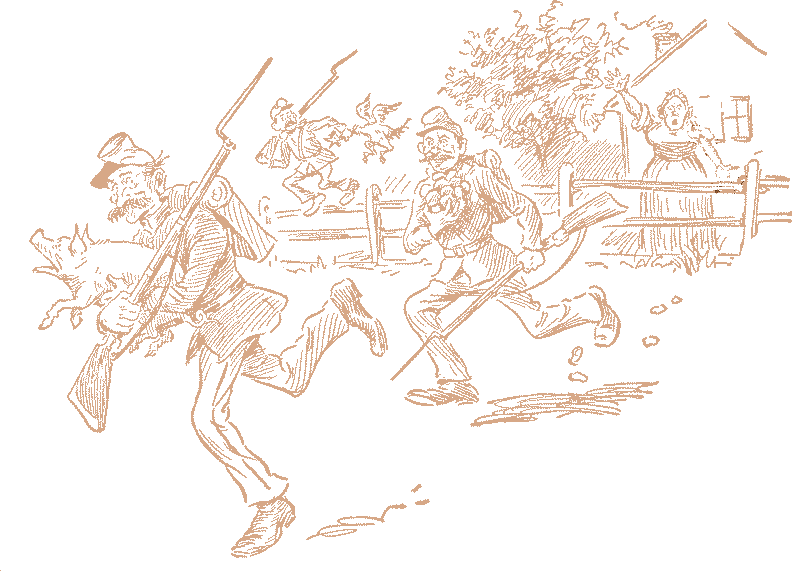 SERGEANT:
Your wife knows where he's hid. SERGEANT:
Your wife knows where he's hid. MARY: I'm sure I wish I did. An' I'd tell ye quick, an' git ye out of here. 'Taint no fun for me to have ye prowlin' all over my house. Ye ain't got no right t' torment me like this. Lord knows how I'll git my day's work done, if I can't have my sleep. SERGEANT: Good God, what a clod! Nothing but her own petty existence. One evening in 1863 in the kitchen of a farmhouse on the border between the Northern and Southern states, Mary is confronted with the greatest experience of her life. A Northern soldier, hunted by two Southern soldiers, seeks refuge in her household. The two Southern officers insult Mary to the point of murder. She endures many moments of horror and then turns on the two men. She takes the old gun from the wall and kills them both. The playwright, whose full name was Emmet Lewis Beach, was from Saginaw, Michigan, and had been a member of George Pierce Baker’s famous 47 Workshop at Harvard. It was there that "The Clod" premiered March 1914. The play gave the Washington Square Players their first big hit, in January 1916, - both critical and box office. It ran for ten weeks, and the group revived it in their summer season, June 1916. Production History "The Clod" premiered on the bill of three one-acts presented as the Harvard Dramatic Club's annual spring production, under the direction of George Pierce Baker. (See picture right.) 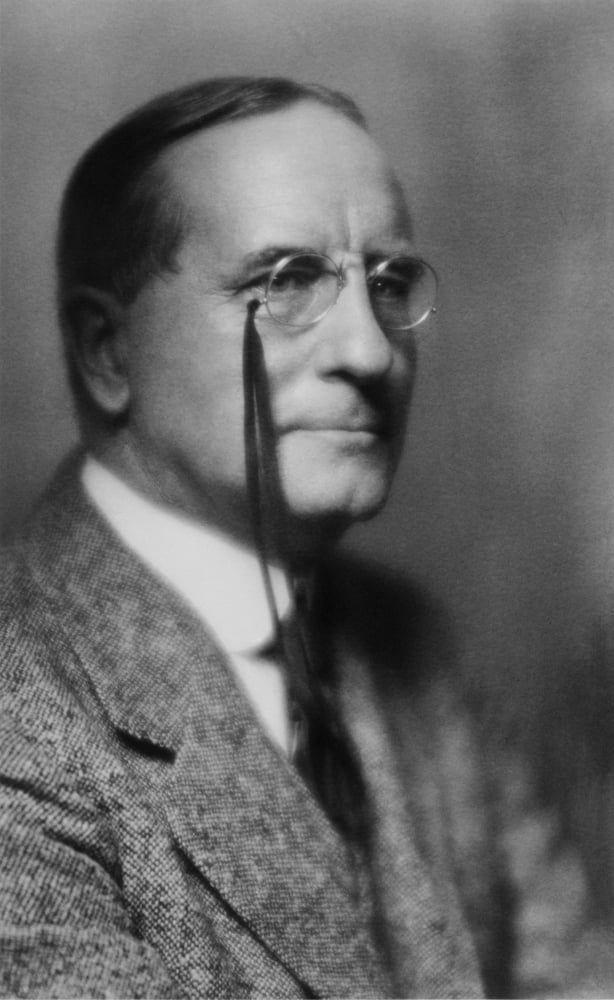 In 1903, Harvard graduate George Pierce Baker (1836-1935) began teaching play writing at Radcliffe, then opened it up to Harvard, then in 1912 included workshops for production for the performance of plays developed within his writing class. Among those he taught were George Abbott, Philip Barry, S.N. Behrman, Hallie Flanagan, Eugene O'Neill, Maurine Dallas Watkins, and Thomas Wolfe. His "Dramatic Technique" offered a codification in English of the principles of the well-made play. For its 1914 spring production the [Harvard] Dramatic Club presented three one-act plays, "The Bank Account," a tragedy, by H. F. Brock; "The Fourflushers," a comedy by Cleves Kinkead; and "The Clod," a war-time drama by E. L. Beach. Performances at Brattle Hall on March 31 and April 2, and in Copley Hall, Boston. on April 3, 1914 "THE CLOD" MARY TRASK. Christine Hayes THADDEUS TRASK. Norman B. Clark A NORTHERN SOLDIER. Dale Kennedy A SOUTHERN SERGEANT. James W. D. Seymour DICK. Richard Southgate [Note: Mary Morris, who appeared in the bill in "The Bank Account" was later to star in "The Clod" with the Washington Square Players. "The Bank Account" would be produced in 1917 by the Washington Square Players. ] 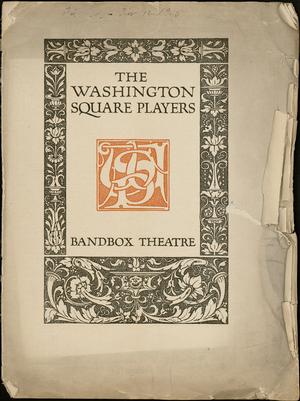 The Washington Square Players was an influential little theater group, which was active from 1915 through 1918, founded by Lawrence Langner, Edward Goodman, Philip Moeller, Helen Westley and others in the thick of the progressive fervor centered in Greenwich Village, leading up to WWI. It was a co-operative undertaking; actors, directors, scene-builders, stagehands, ushers were all amateurs. The opening performance, in February , 1915, at a tiny playhouse in the East Fifties appropriately called the Bandbox, was a significant event in the history of the American theatre. In a sense, it sounded the first note of the movement that was to vitalize the American drama in the 1920s. The plays, while in the main not especially noteworthy, were in refreshing contrast to the stale, pre-digested fare of the commercial theatre. The whole undertaking was a step toward the establishment of a much-needed adult American theatre. In time, the Washington Square Players would move into a larger theatre (with a revival of "The Clod" on the opening bill), produce off-season national tours with their actors and strongest plays, open a training school, and even rent out their scene and costume shops to commercial Broadway producers. Per founder Lawrence Langner: In the short three years from 1915 to 1917, the Washington Square Players presented sixty-two one-act plays ... the list included O'Neill, Zoe Akins, Theodore Dreiser, Susan Glaspell, Zona Gale. For good measure there were long plays, including Chekhov's The Seagull. Ibsen's Ghosts, Shaw's Mrs. Warren's Profession. World War I would spell the end for the profoundly influential Players, who would re-emerge as the majestic Theatre Guild after the war. But before closing down they had changed the American stage forever and planted the seed that would, over the next fifty years, grow into Off and Off-Off Broadway. "The Clod" was produced by the Washington Square Players, under the direction of Holland Hudson, at the Bandbox Theatre, New York City, beginning January 10, 1916. 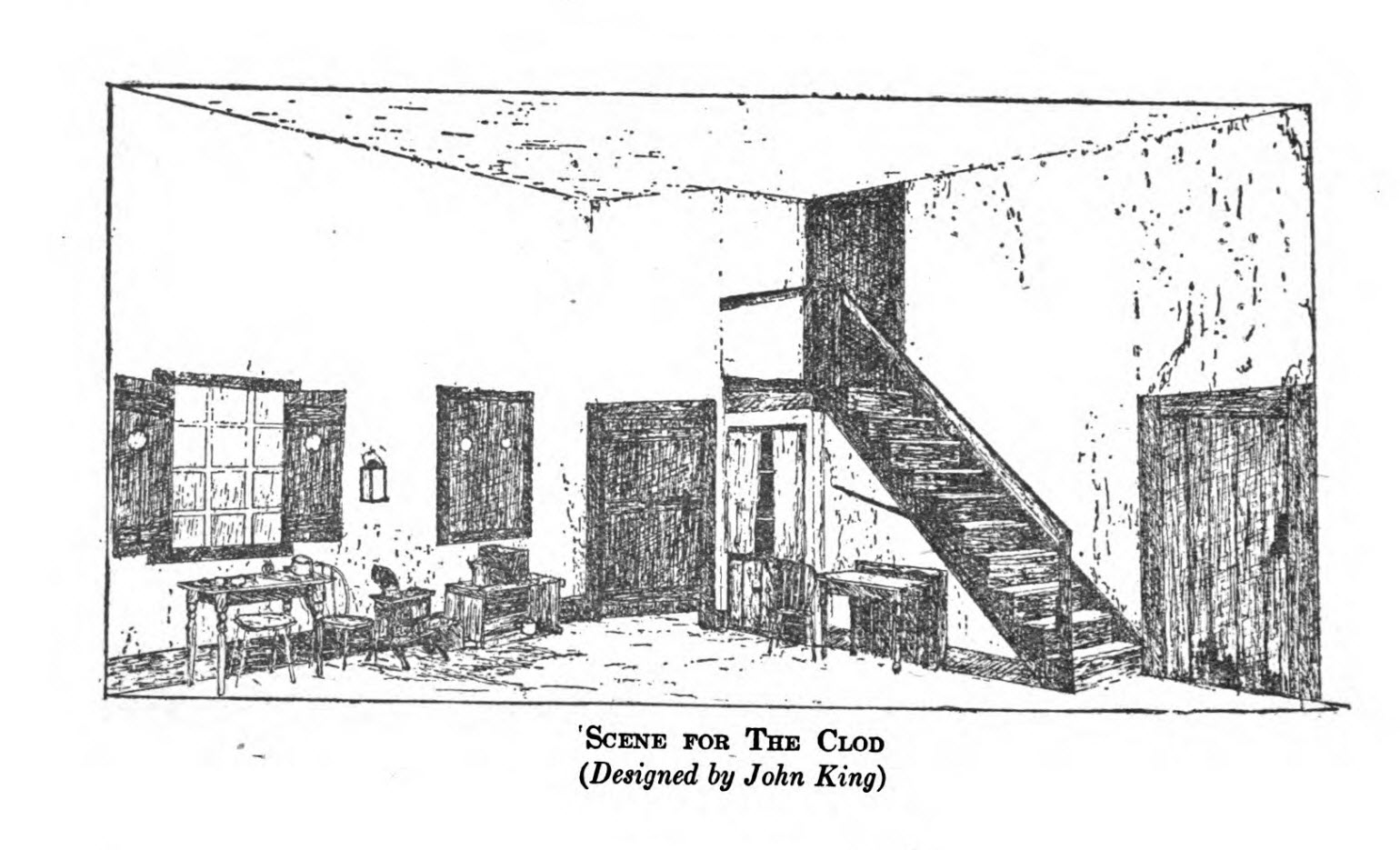 In
the cast, in the order of their appearance, were the
following: In
the cast, in the order of their appearance, were the
following:MARY TRASK. Josephine A. Meyer THADDEUS TRASK. John King A NORTHERN SOLDIER. Glenn Hunter A SOUTHERN SERGEANT. Robert Strange A SOUTHERN PRIVATE. Spalding Hall The Scene was designed by John King. (See picture left) "The Clod" was subsequently revived by the Washington Square Players at the Comedy Theatre, New York City, beginning June 5, 1916. In this production Mary Morris played the part of Mary Trask.  One-act plays found a commercial life in Vaudeville. Referred to as "playlets" these twenty minute dramatic presentations might be comic or tragic, might be a condensed version of a Broadway hit or a Shakespeare classic and might showcase a famous theatre name of the day, like Sarah Bernhardt or the Barrymores. Pulitzer prize-winning playwright George Kelly wrote "playlets" directly for vaudeville, as did the young George Cohan. Washington Square Player's Alice Gerstenberg's "The Pot Boiler" was well-received in vaudeville. The "playlet" became a staple of the vaudeville bill, the cast of a playlet rehearsed in New York and then were booked in vaudeville houses throughout the United States, alongside jugglers, singers, comedians, magicians, monologists, dancers, acrobats, dog acts, sports figures and headliners from the newspapers. But as Brett Page noted in 1915 is his "Writing for Vaudeville," (a highly recommended read): ... no two 'single' singing acts should be placed next each other--although they may not conflict if they are placed far apart on the bill. And no two 'quiet' acts may be placed together. The tempo of the show must be maintained--and because tragic playlets, and even serious playlets, are suspected of 'slowing up a show,' they are not booked unless very exceptional."  "The Clod" must have been exceptional.
Sharing the bill with the likes of the Four
Readings, Jugglers of Human Beings, Jo0h Geiger and his
Talking Violin and closing the show Vanda Hoff, the
Dancing Girl of Delhi ... "The Clod" must have been exceptional.
Sharing the bill with the likes of the Four
Readings, Jugglers of Human Beings, Jo0h Geiger and his
Talking Violin and closing the show Vanda Hoff, the
Dancing Girl of Delhi ..."The Clod" was presented in vaudeville by Martin Beck, opening at the Palace Theatre, New York City, August 21, 1916, with the following cast: MARY TRASK. Sarah Padden THADDEUS TRASK. John Cameron A NORTHERN SOLDIER. Glenn Hunter A SOUTHERN SERGEANT. Thomas Hamilton A SOUTHERN PRIVATE. Gordon Gunnis Nov 20, 1916, San Francisco Chronicle, Walter Anthony: A sketch so good as "The CLod" and acting of the high type of MIss Padden's merit better tgreatment at the hands of the producers. One window, last night, looked out ona field of glowing green ... in a nice warm afternoon sun. The other window looke out aon a landscaoe flooded with purple which scene painters have come to believe is midnight. Out of one windwon itwas 2pm bbut ouf ot the other it was 1am. The srtov4 bafly in need of a chimney and thehshotgun had tyhe familiar look of recent sportmsmsn goods. In '63 they had no guns like that. But Miss Paddon overwhelms the scenery and the play itself rises supremely above the environment. References in the Play George Pierce Baker's playwriting class assignments included finding a short story to adapt. Out of that "The Clod" emerged, based on the shorty story "The Least of These," by Donal Hamilton Haines. Baker uses the play as an example in his course text, "Dramatic Technique" (1919): Scenes, which in the original story occurred upstairs or downstairs, inside or outside a house, may often be easily interchanged or combined. The Clod, by Lewis Beach, a one-act success of the Washington Square Players, in its first draft showed a setting both upstairs and downstairs. This unsightly arrangement was quickly changed so that all the action took place in a lower room. In any introduction of the play, Lewis Beach prominently acknowledges writer / journalist Donal Hamilton Haines, also from Michigan, albeit Kalamazoo, for "The Least of These." Haines was a graduate of the University of Michigan '09 who went on to lead a long prolific life as a journalist / fiction writer - travel writing and sports, war stories and fantasy - an a professor of journalism and English at his alma mater. Haines' "The Least of These," appeared in Metropolitan Magazine, June 1913. Metropolitan Magazine was one of the many story magazines that proliferated at that time, and provided a livelihood for nascent journalists, playwrights and novelists on their way to their major work. Publications Washington Square Plays," Volume XX of the Drama League Series of Modern Plays, (Doubleday & Son, New York, 1916): "The Clod" was first published as part of the "Drama League Series of Modern Plays." The Drama League was founded in Chicago in 1910 as the Drama League of America. The national organization was created with two primary objectives: to influence the professional production of the best new American plays by alerting members to performances that warranted their support; and to ensure the continuity of professional theatre by educating the audiences of the future. Thy published as monthly magazine, Drama and they published what they considered to be important plays: The Drama League of America believe that the full purpose of their organization can be realized only when the general average of audiences in the American theatre shall attain to a degree of intelligence in regard to the drama in some way comparable with that to be found in the theatres of Europe. They believe that one of the most important elements in the product of European audiences has been the opportunity given them, individually and continually, to study the drama in its printed form, both before and after its presentation upon their stage. By this means are they kept acquainted with all important dramas as they are produced, or before they are produced, in the leading theatres of their own or other countries." Usually, each volume in the series contained one full length play. For Volume XX, the board wanted to promote the work and mission of the Washington Square Players to its national network of theatre artists. They published four one-acts as "Washington Square Plays," and had nationally synidcated Walter Pritchard Easton, theatre critic and columnist write a preface and had Edward Goodman, the artistic director of the Washington Square Players write an introduction. The other plays were "Overtones" by Alice Gerstenberg, "Eugenically Speaking" by Edward Goodman and "Helena's Husband" by Philip Moeller. Reviewing the volume, Sheldon Cheney wrote in Theatre Arts Magazine, February, 1917 that: The only one of prime importance because the only one marked by sincerity without cynicism, is the now famous little tragedy by Lewis Beach, "The Clod." It is powerfully realistic and compellingly dramatic. [The rest] are notably clever in parts; but ... marred ...by the smartness and shallow philosophy that vitiate much of the output of the Washington Square school. The book is well worth owning. In his introduction to the Volume, critic Walter Pritchard Easton: In these four plays , then , written for the Washington Square Players , the one - act form demonstrates its right to our attention and cultiva tion , for it takes interesting ideas or situations which are incapable of expansion into longer dramas and makes intelligent entertainment of what otherwise would be lost . Brentano's Publishers New York, published "The Clod" in Four One-Act Plays by Lewis Beach. (Brentano's, N. Y. 1921) along with “A Guest For Dinner,” “Love Among the Lions,” and “Brothers”. Brentano's published "Ten One-Act Plays " by Alice Gerstenberg, concurrently, to cash in on the "little theater" movement expanding across the country. The reviewer in Theater Arts Magazine noted that Miss Gerstenberg's "Overtones" and "The Pot Boiler" have more really theatrical possibility in them, vaudeville especially, than have any of Mr. Beach's plays . But on the other hand Mr. Beach's "The Clod" has more pungency and bite than any of the more plausible achievements in the other volume . But in general the two volumes are the same kind of thing ; the plays in each are at bottom more or less mere arrangements , cooked - up situations , with rather flat dialogues and empty turns and reactions . They have no important reality . But they evidently meet a certain need since a number of them have already had a good deal of success in little theatres and amateur organizations. For purposes of performance and the royalties due therein, Samuel French published "The Acting Edition" of "The Clod". And for purposes of legacy, John Gassner in 1949 included "The Clod" as one of the Twenty-five Best Plays of the Modern American Theatre : early series / edited with an introduction by John Gassner. - New York : Crown. Critical Reception of "The Clod" ARPIL
1, 1914 HARVARD CRIMSON: PRAISE FOR DRAMATIC CLUB. DR.
BERNBAUM, Professor of English, SAYS "THE CLOD"
APPROACHES PROFESSIONAL EXCELLENCE. By far the best performance of the evening was that of "The Clod." Here the acting was so good as to make the illusion complete, and one became absorbed wholly in the story. It is a tale of the Civil War, but that threadbare theme appears for once in a new and surprising form. The principal character a woman too dull to apprehend the great meanings of the conflict, too apathetic to be moved by the peril of thirty thousand men, is by an insult which would seem comparatively trivial to others, but which wounds her only pride, suddenly turned into a fury of righteousness, and, without knowing it, becomes a national heroine. This may be melodrama in its superficial appearance, but at bottom it is something far better. I am greatly mistaken if "The Clod" is not the best one act drama that has been seen here for several years, and if it has not all the essential qualities of well merited success on the professional stage. JANUARY 11, 1916 NY Times: "The Clod," by Lewis Beach, is of the Princess and Grand Guignol school of playlets. It is an episode in the kitchen of a poverty stricken farmhouse one night of the civil war, where two Southern soldiers come in search of a wounded Yankee. The drawing of the character of the mistress of the house to whom the fact that the muddy feet of the men have made more work for the morrow is of greater import than the fate of the pursued, who holds the safety of an army in his keeping has been Mr. Beach's chief concern and he has done his work with much skill. JANUARY 16, 1916 Alexander Woolcott Second Thoughts on First Nights: The first is a playlet, an excruciating tense little melodrama called "The Clod." They play it by moonlight, with the prospect of immediate gunfire continuously suspected like the Sword of Damocles over the head of the jumpy playgoer ... a dramatic study of the puzzled indifference of the peasant amid the mighty conflict of nations and dynasties. JANUARY 22, 1916, The New Republic "After the Play": ...the new bill at the Bandbox is a success. It was well worth all the self-indulgent experimentation of the lighter pieces, well worth all the concession to stock whimsicality and humor, to have made so fortunate production as "The Clod." If comedy fails it is like a slip in dancing. One risks humiliation. But if a tragedy fails one endangers everything. It is like a slip of the surgeon's knife. And that failure, so common in the XXXlacertain, scarring productions of the Grand Guignol, is beautifully avoided in Mr Beach's short play, "The Clod." Mr. Beach gives us one little incident of the Civil War ... there is a swift and dreadful climax, the scene rings true. That the Washington Square Players can discover, stage and manage such genuine pieces as "The Clod" is by all odds the main feature of their experiment. Triumphs may eventually be achieved in bijou productions, pantomimes,skits and "incidental tinklings." But even with symptoms of New York smartness in this direction there is ample compensation in the Clods.  1916, American Yearbook, The Drama, Walter Pritchard Easton: The Clod" by Lewis Beach, a melodramatic tragedy of our Civil War but with a real spiritual significance ...stood out above the general level of the year... effective in the theatre and when read ... would bear enduring and thoughtful scrutiny ... In short ... genuine dramatic literature. FEBRUARY 26, 1916, Plays and Players, Walter Pritchard Easton: The play on the bill, by the way, is a capital piece of work, capitally acted. Already, year after year, these players many of whom began as amateurs, are showing what training can do. The play is called "The Clod." The author is Lewis Beach, a recent graduate of Harvard. The scene is in a poor farmhouse on the border between north and south in our civil war. It is night. The sketch is thrilling in its suspensive excitement. It is a little gem. It is a native work all through and significant work. FEBRUARY, 1916, Munsey's Magazine, The Stage: In the current bill at the Bandbox is to be found an unusually good speciman of that lately despised brand, the war play. It is called "The Clod" by a newcomer in the game, Lewis Beach, about whom nothing seems to be known beyond the fact that he hails from Harvard. The scene is laid on the border-line between the North and the South in 1863 ... the character from which the piece takes its name - this human clod being the wife of a poor farmer who has no interest in either the North or the South and only wishes that the soldiers would go away and leave her in peace. JUNE 14, 1916 "Alan Dale Says..." Syndicated: "The Clod" ... a very excellent little play, clever and unique ... was worth while the attention of the serious critics ... made the initial effort of the W  ashington Square
Players interesting to any audience. For this playlet
I was duly thankful. I don't mean to say that
have never seen anything as good presented by naughty
Broadway actors. That would be an absurd
statement. "The Clod" merely showed that these
unknown people could do things quite as well as we
were accustomed to see them done on Broadway. ashington Square
Players interesting to any audience. For this playlet
I was duly thankful. I don't mean to say that
have never seen anything as good presented by naughty
Broadway actors. That would be an absurd
statement. "The Clod" merely showed that these
unknown people could do things quite as well as we
were accustomed to see them done on Broadway.
NOVEMBER 20, 1916 San Francisco Chronicle, "Dramatic One-Act Tragedy on Orpheum Bill," Walter Anthony: There is a one-act drama newly come to the Orpheum which you should not miss. ... "The Clod" has the spark. It touches big themes, though doesn't seem to try to. It is simple as a DeMaupassant story, as primitive and odorous of the healthy soil. And it has the DeMaupassant surprise which chills and thrills in the very last line. I would not deprive you of the shock and the surprise set up in the sketch just before the curtain falls. But there are three prone still bodies on the floor and a smoking shotgun to prove the truth that tragedy has stalked by this shack in the mountains where the blue and the grey are fighting. DECEMBER 19, 1916 LA Times, Edwin Schallert: ...a playlet of rare and different quality ... It is like a fragment from a Tolstoi masterpiece, and an illumination of the soul of sordid realism ... an epic of dull souls, its pathos lying in the total helplessness of its characters to grapple with fate, their pitiful unpreparedness in the face of disaster which takes form when insult and calumny are heaped upon them by the soldiers who have gained possession of their home. At last when Mary Trask, blind with rage, her nerves giving way, shoots the soldier, she doesn't cry, "Death to the tyrant," nor any such high-sounding stuff. But as the curtain goes down, she cries out of the tragedy of dullness that has been her life: "He's broke my only cup, he has! Now I've got to drink out of the tin dipper!" Which strikes the keynote purpose to the pitifulness of all such dun-colored lives as hers and her husband's. 1917, Intro to the publication of "Washington Square Plays," critic Walter Pritchard Easton: "The Clod” approaches the true episodic roundness of the one - act drama , or the short story , in its best estate . Here is a single episode of reality , taken from its context and set apart for contemplation. It begins at the proper moment for understanding , it ends when the tale is told . There is here more than a hint of the art of Guy de Maupassant . And the episode is theatrically exciting - a prime requisite for practical performance , and spiritually significant - a prime requisite for the serious consideration of intelligent spectators. JANUARY 14, 1917 Plays and Players: Sarah Paddon in "The Clod" is one of the type of vaudeville productions that grips and holds you from start to finish. Few sketches on the Orpheum or any other circuit contain the thrill and punch of "The Clod," and the public soon will have the opportunity of sharing with the critics the opinion that in this offering Mr. Martin Beck has "put over" a big thing. Biography Pictures in this section 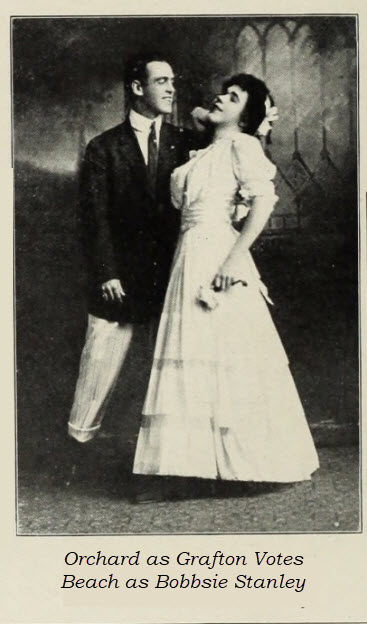 From University of Chicago, Cap and Gown
1910, from the Blackfriar's Pseudo-Suffragettes From University of Chicago, Cap and Gown
1910, from the Blackfriar's Pseudo-Suffragettes"The Jones Family, Young as You Feel," 1940 20th Century Fox (based on "Merry Andrew') "Handy Andy", 1934 Fox (based on "Merry Andrew') "This Reckless Age" 1932 Paramount (based on "The Goose Hangs High") "The Denial" 1925 Metro-Goldwyn (based on "The Square Peg") "The Goose Hangs High" 1925 Paramount "The Good Hangs High" 1936/7, The Federal Theatre Project Emmet Lewis Beach, Jr. was born June 18, 1891 and raised in Saginaw, Michigan, a thriving lumber town in the 19th century and an important industrial city and manufacturing center throughout much of the 20th century. His father was one of the leading attorneys in Saginaw, who dedicated much of his life to public service, elected to the office of City Attorney, then Circuit Judge of Saginaw County, returning after six years to private law practice, where he founded and presided over the German-American State Bank and served as officer of a variety of local corporations. He was often called to speak at civic and political functions. He was a prominent citizen. In 1888, Judge Beach was married to Miss Leah Dudgeon, Irish born, a school teacher, who grew up in Saginaw. It has been suggested that she was the artistic influence upon Emmet, Jr., and his younger brother Robert Stanley Beach, born 1895.  Emmet attended Saginaw public schools, and entered the
University of Chicago 1909, participating in the glee
club and the dramatics society. His nickname was
"Rex," perhaps after "Rex Beach," a novelist also from
Michigan who specialized in very popular wilderness
adventure stories - what Critics described the "he-man
school" of literature: stories of "strong hairy men
doing strong hairy deeds"
Emmet attended Saginaw public schools, and entered the
University of Chicago 1909, participating in the glee
club and the dramatics society. His nickname was
"Rex," perhaps after "Rex Beach," a novelist also from
Michigan who specialized in very popular wilderness
adventure stories - what Critics described the "he-man
school" of literature: stories of "strong hairy men
doing strong hairy deeds" In years to come, Beach was remembered for his performance with the 1910 Blackfriars, a theatre club formed in late 1903 by Frank R. Adams, named after the notable theater of Elizabethan London, and inspired by Harvard's Hasty Pudding, Princeton's Triangle, and other early collegiate musical comedy groups. Membership was restricted to male students, and included one man from each University fraternity as well as any campus actors "fitted for amusing themselves and others". The new organization proved to be so popular that original Blackfriars musical comedies became an eagerly awaited feature of every spring season. In 1910, the Blackfriars original musical, "Pseudo-Suffragettes" featured freshman Emmet L. Beach in the role of "Bobbsie Stanley, a college ingenue." (See picture right.) Beach found his way to Harvard University for his junior and senior years, graduating with a BA in English in 1913. It was here that his talent as a playwright flourished under George Pierce Baker and his playwriting program developed for Harvard and Radcliffe, including the 47 Workshop founded in 1912 to put the more interesting plays from Baker's classes into production by the Harvard Dramatic Club. Beach's first full-length play, "Let's Get Married," a farce about the collision of three concurrent elopements, was presented by the Harvard Dramatic Club in December, 1913, awarded the Dramatic Club Prize and published for amateur production by Walter H. Baker & Co. Boston, 1916. Beach earned his Master of Arts, June of 1914. In the fall of 1914, he r  eceived a
year's appointment as teaching assistant to Baker
(which was renewed in the fall of 1915). eceived a
year's appointment as teaching assistant to Baker
(which was renewed in the fall of 1915). That spring the 47 Workshop produced Beach's "The Return of the Prodigal." March 1915. Eugene O'Neill arrived in Cambridge in the fall of 1914 though never completed the 47 Workshop. It can be assumed that Beach, as Baker's teaching assistant, was acquainted with him. The workshop had connections to the burgeoning little theatre movement in Greenwich Village: Lee Simonson, Harvard '09 studied with Baker, and was one of the founders of the Washington Square Players (which produced "The Clod"); Two plays that shared bills with Lewis Beach, "Plots and Playwrights," by Edward Massey ' and H. F. Brock "The Bank Account", both made their way into the "Washington Square Players' repertory. Two playwrights who became mainstays of the Theatre Guild, Sidney Howard studied with Baker in 1915 and S.N. Behrman in 1916, while Beach was there. According to Wisner Payne Kinne, in "George Pierce Baker and the American Theatre," Baker himself was a close associate of New York theater managers who looked to him for the material techniques and ideological framework—and, of course, the writers—of a new mode of dramatic realism. As the “father of modern American playwrights” according to his obituaries, he was certainly well connected within that industry. He no doubt championed Lewis Beach, whose premiere in New York in 1916, "The Clod" with the Washington Square Players at the Bandbox Theatre was auspicious indeed. Beach's body of work is modest, though always greeted with serious critical consideration if not audience popularity. There is a series of one - act plays: "The Brothers," who squabble over their father's will, presented by the Provincetown Players in 1920; "Guest for Dinner," first acted at the Playhouse, Lake Forest, 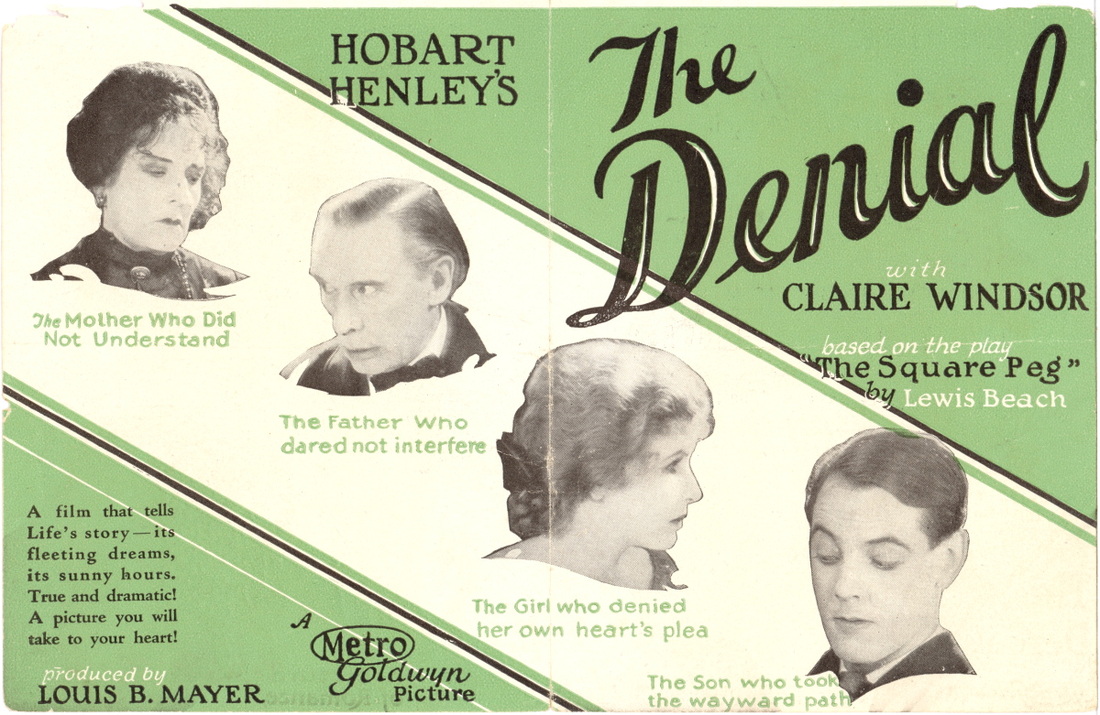 August,
1916; a farcical look at the egoism of opera-singers,
"Love Among the Lions," 1919 and "The Clod," 1916)
. There are severql full-length Broadway plays (
“ The Square Peg ” 1923 , "Anne Vroome"
1924, “ The Goose Hangs High ” 1924, "Merry
Andrew", 1929) Lewis Beach studied the
characters of common people under the domination of
the pettiness of everyday experience. “
The Square Peg ” ( 1923 ) tells the story of the
economies , intrusions , misplaced duties of a futile
family that is dominated by a “ capable ” mother .
"Anne Vroome" follows a daughter who has sacrificed
her happiness to the care of her aging parents,
unsupported by the rest of her family. “The
Goose Hangs High ,” a big light comedy hit though not
as critically welcomed, also a story of domineering,
selfish family figures. August,
1916; a farcical look at the egoism of opera-singers,
"Love Among the Lions," 1919 and "The Clod," 1916)
. There are severql full-length Broadway plays (
“ The Square Peg ” 1923 , "Anne Vroome"
1924, “ The Goose Hangs High ” 1924, "Merry
Andrew", 1929) Lewis Beach studied the
characters of common people under the domination of
the pettiness of everyday experience. “
The Square Peg ” ( 1923 ) tells the story of the
economies , intrusions , misplaced duties of a futile
family that is dominated by a “ capable ” mother .
"Anne Vroome" follows a daughter who has sacrificed
her happiness to the care of her aging parents,
unsupported by the rest of her family. “The
Goose Hangs High ,” a big light comedy hit though not
as critically welcomed, also a story of domineering,
selfish family figures.  His work is published: Four One-Act Plays (Brentano's, N. Y. 1921) contains “The Clod,” “A Guest For Dinner,” “Love Among the Lions,” “Brothers”; “Let's Get Married” (W.H. Baker, Boston, 1913); “The Goose Hangs High” (Little Brown N. Y. 1924); “Ann Vroome” (Little Brown Boston, 1924); “A Square Peg” (Boston, 1924). Samuel French has published acting editions of "Merry Andrew", published 1930 and "In A House Like This." (1940) "The Goose Hangs High" was adapted for the silent screen (1925) and later for talkies ("This Reckless Age" 1932), it was performed on the Lux Radio Theatre (1934) and it was a regional entry in the Federal Theatre Project during the depression. Beach wrote a sequel, "In a House Like This" which Samuel French published directly for the Little  Theater
market. Theater
market.His other plays found life on film, "The Square Peg" was adapted for the silent film, "Denial" (1925); And "Merry Andrew" was adapted for film twice, Handy Andy (1934) with Will Rogers and "Young as You Feel" (1940) . For all of Emmet Lewis Beach's promise, there are curious facts that lead one to construct a rather haunted narrative to the second half of the man's life. His brother Robert went into business with their father, served in WWI, married and had a daughter. Emmet did none of those things. He was deferred from service for his eyesight and never married. Though there is some evidence of incomplete new works, his career seems to have foundered after 1930, and he returned home to Saginaw, Michigan. If we assume Leah Dudgeon Beach was the model for the intimidating mother-figures who dominate his plays, it must have been a lonely final chapter, watching over her, and struggling to complete new work. September 3, 1947, age 54, he was found dead of "natural causes" by his mother, in his cottage on Point Lookout, where Lake Huron meets Saginaw Bay. Metropolitan Playhouse S  aturday,
September 26, 2020, 8 PM aturday,
September 26, 2020, 8 PM
The Clod by Lewis Beach Directed by Alex Roe Brad Fraizer, David Logan Rankin, Suzanne Savoy, Joshua David Scarlett and Thomas Vorsteg  Followed by a talkback with guest scholar Followed by a talkback with guest scholarErin Stoneking Assistant Professor Gender & Race Studies at the University of Alabama Dr. Erin
Stoneking is an assistant professor in the department of
Gender & Race Studies at the University of Alabama.
She holds a Ph.D. in Performing and Media Arts from
Cornell University and an M.A. in Performance Studies
from New York University. Her current research project
investigates contemporary embodied encounters with the
U.S. Southern past, with an emphasis on
counter-hegemonic performance practices. Also a
dramaturg, Erin most recently served as the Resident
Dramaturg for English Theatre Düsseldorf in Düsseldorf,
Germany.
|
|
|
 |
|