
Metropolitan Playhouse
The American Legacy
The American Legacy
"Theatrical
archaeologist extraordinaire" - - Back Stage

Follow us....


|
Metropolitan Playhouse
The American Legacy "Theatrical
archaeologist extraordinaire" - - Back Stage
|
Follow us.... |
|||||||
| Playing | Next | Season | Tickets | Company | Location | Mission | History | Links |
|
| The
PARLOR CAR Farce |
|
|
|
|
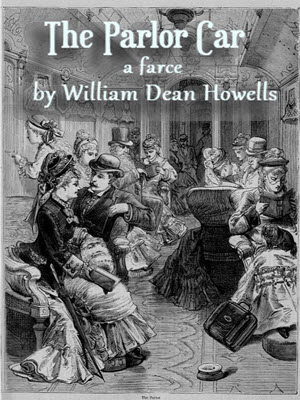 “You must tell me,
dearest, what I have done to offend you. The
worst criminals are not condemned unheard. And
now I only ask you to be just.”
“You know very well what you’ve done. You can’t expect me to humiliate myself by putting your offence into words.” “Upon my soul, I don’t know what you mean! I don’t know what I’ve done. ” 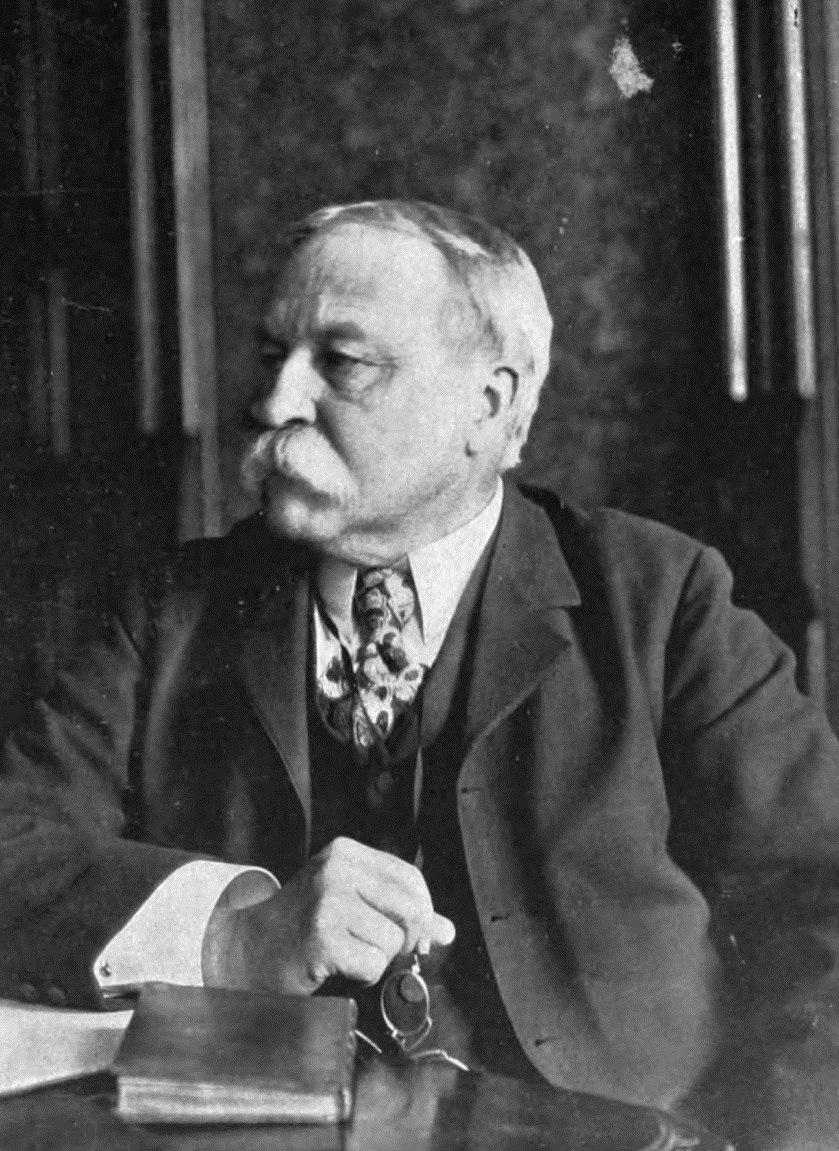 William Dean Howells and Drama as Literature William Dean Howells (1837-1920), American writer and editor, was an influential critic and an important novelist of the late 19th century. His career spanned a period of radical change from European influenced conventions in American literature to Realism; as novelist, critic, and editor, he contributed greatly to those changes. His novels appeared almost every year from 1987 to 1921, he managed to write six autobiographical studies, more than a dozen travel books, four volumes of poetry, numerous memoirs, biographies and reviews. And 30 plays. He was not known for these dramatic efforts, which were far more literary than stage-worthy. Rather than receiving professional productions, these one-acts plays were published regularly for review in literary digests, principally The Atlantic Monthly and Harper's. His plays were described as 'closet dramas' for reading and not necessarily performing and he was meticulous in crafting his stage directions as he was in his dialogue. He enjoyed exploring realism in the dramatic form, as with his novels, to tell the truth of the everyday lives of Americans. He had no interest or talent for the role of Actor/Manager, the only way a playwright could earn a living in early 19th century American theatre. His first published play was, in fact, The Parlor Car published in The Atlantic Monthly, August, 1876. (See the illustration above right.) after he had already written three novels, a book of poems and numerous articles and essays. Realism in American Plays Melodrama The drama of the pre-war period tended to be a derivative in form, imitating European melodramas and romantic tragedies, but native in content, appealing to popular nationalism by dramatizing current events and portraying American heroism. But playwrights were limited by a set of factors, including the need for plays to be profitable, the middle-brow tastes of American theater-goers, and the lack of copyright protection and compensation for playwrights. The primary 19th Century Theatrical Form was melodrama, despite other influences, becoming the most popular by 1840. Characteristics of Melodrama: 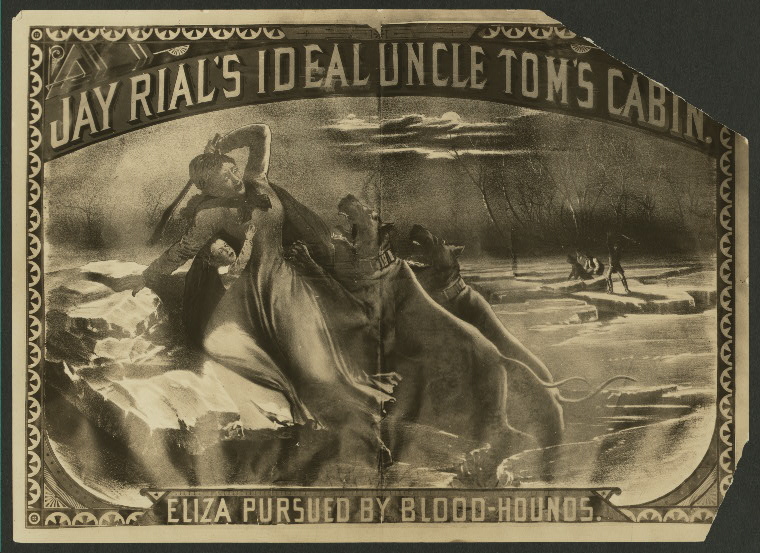
The Rise of American Realism  Many cultural currents influenced the introduction of a realistic approach to dramatizing contemporary life. One would hope that the Civil War and the assassination of a President (in a theatre no less!) was enough melodrama for a generation of Americans. The nation's growth and prosperity was spurred on by a mix of post-war progress such as the successful connection of the transatlantic telegraph cable (1866) and the first transcontinental railroad completed in United States (1869); international advances in medicine and science such as pasteurization and "The Origin of the Species"; and a continuous wave of European immigration and the rising potential for international trade. Through all mediums including painting, literature and music, American Realism attempted to portray the exhaustion and cultural exuberance of the figurative American landscape and the life of ordinary Americans at home. Artists used the feelings, textures and sounds of the city to influence the color, texture and look of their creative projects. Musicians noticed the quick and fast-paced nature. Writers and authors told a new story about Americans; boys and girls real Americans could have grown up with. Pulling away from fantasy and focusing on the now, American Realism presented a new gateway and a breakthrough - what it means to be in the present. The earliest period of American realism in drama can be dated 1870 to 1900. Elements of dramatic realism were finding their way into melodrama (e.g., Augustin Daly's "Under the Gaslight") and in local color plays (Bronson Howard's "Shenandoah" pic left). Other key dramatists during this period were David Belasco (pic right, "Girl of the Golden West"), Steele MacKaye, our man William Dean Howells, Dion Boucicault, and Clyde Fitch. Realism onstage called forth a set of dramatic and theatrical conventions with the aim of bringing a greater fidelity of real life to texts and performances:
The other novelists whose works were considered part of this 19th century movement included Stephen Crane, Horatio Algier, Henry James and, of course, William Dean Howells. Howells and Realism in Dramatic Literature  The
greatest
literary
influence
exerted on
Howells was by
the writer
whom he called
"one of the
greatest
realists who
has ever
lived" --
Carlo Goldoni
(1707-1793),
the Italian
playwright and
librettist
from the
Republic of
Venice.
His works
include some
of Italy's
most famous
and best-loved
plays.
Audiences have
admired the
plays of
Goldoni for
their
ingenious mix
of wit and
honesty. His
plays offered
his
contemporaries
images of
themselves,
often
dramatizing
the lives,
values, and
conflicts of
the emerging
middle
classes. The
greatest
literary
influence
exerted on
Howells was by
the writer
whom he called
"one of the
greatest
realists who
has ever
lived" --
Carlo Goldoni
(1707-1793),
the Italian
playwright and
librettist
from the
Republic of
Venice.
His works
include some
of Italy's
most famous
and best-loved
plays.
Audiences have
admired the
plays of
Goldoni for
their
ingenious mix
of wit and
honesty. His
plays offered
his
contemporaries
images of
themselves,
often
dramatizing
the lives,
values, and
conflicts of
the emerging
middle
classes. There is abundant evidence that the Venetian dramatist more than any other writer, turned Howells from Romantic poet into prose Realist. It was through Goldoni's eyes that Howells, on assignment as consul to Venice from 1861-1865, first saw the possibilities of prose fiction based on the commonplace events of contemporary life. Later Goldoni's plays provided direct inspiration for his own comedies and farces. Howells, (in "My Literary Passions," 1895): "I had a notion that, in literature, persons and things should be nobler and better than they are in sordid reality; and this romantic glamour veiled the world to me, and kept me from seeing things as they are. But in the lanes and alleys of Venice I found Goldoni everywhere. Scenes from his plays were enacted before my eyes, with all the charming Southern vividness of speech and gesture, and I seemed at every turn to have stepped unawares into one of his comedies. " Howells defines Goldoni's elements of realism, as if he is talking about his own: "a) the truthful treatment b) of commonplace material, which produces c) proper moral effect," ".. there is seldom anything more poignant in any one of [Goldoni's plays] than there is in the average course of things. The plays are light and amusing transcripts from life, for the most part, and where at times they deepen into powerful situations, or express strong emotions, they do so with persons so little different from the average of our acquaintance that we do not remember just who they are." "I know none of his plays that insults the common sense with the romantic pretense that wrong will be right if you will only paint it rose-color. He is at some obvious pains to 'punish vice and reward virtue' ... no feigning that passion is a reason or justification ... nor that suffering of one kind can atone for the wrong of another." The Railroad Plays There are four plays in the Howells canon that take place in and around trains, The Parlor Car,"The Smoking Car," "The Albany Depot" (see illustration at left) and "Room Forty-Five." The designation, "The Railroad Plays" was applied by Alan Ackerman, a theater scholar, as a point of discussion for the Dramatic Realists' appropriation of common public spaces as settings for private intimate exchanges between characters. [American Literary Realism, 1870-1910 Vol. 30, No. 1 (Fall, 1997)] Ackerman notes this as a fundamental difference between late 19th century realistic drama and the romantic melodrama that came before it, the notion of a transparent "fourth wall" through which the audience unobserved can peer into the private world of the play. In general Howells' plays mock overt theatricality and focus on the ordinary and intimate experiences of the upper-middle class, experiences that are represented primarily in talk. The refinement or "culture" of the characters and the literary quality of the plays themselves are thrown into relief particularly when they are set in erstwhile public spaces such as railroads or hotels, where the principals encounter by chance less privileged characters and physical conditions. The everyday settings of his plays include a hotel, a New York apartment, a train-car: natural places where people easily meet. The incidents are those of real events rather than fictions but drawing room comedy and depend for the their effect on the subtle contract of social values. These settings and events produce scenes in which one meets probability in everything ... 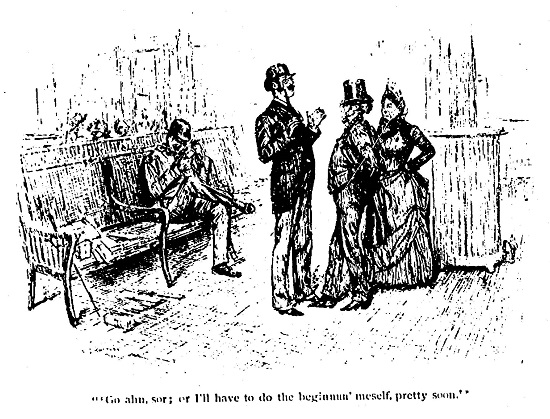 The Parlor
Car,
written 1876,
was not only
the first of
the so-called
railroad plays
but was in
fact the first
of
Howells' 25
one-act
dramas.
The injection
of private
intimate
experience
into public
space became a
crucial aspect
of American
life as the
19th century
wore on,
Howells was a
primary
theorist of
this
shift.
It is,
therefore, no
mere
coincidence
that four of
Howells's
situation
comedies, a
genre to which
he devoted
considerable
energies for
thirty-five
years, are set
in railroad
cars or
depots.
The Parlor
Car,
written 1876,
was not only
the first of
the so-called
railroad plays
but was in
fact the first
of
Howells' 25
one-act
dramas.
The injection
of private
intimate
experience
into public
space became a
crucial aspect
of American
life as the
19th century
wore on,
Howells was a
primary
theorist of
this
shift.
It is,
therefore, no
mere
coincidence
that four of
Howells's
situation
comedies, a
genre to which
he devoted
considerable
energies for
thirty-five
years, are set
in railroad
cars or
depots.This little play transforms a public space into a private situation and in doing so it is emblematic of the transformation of American theatre in the second half of the nineteenth century. The trajectory of an American theatre of rowdy spaces of audience visibility and auditability transforming to darkened auditoriums habituated by only a small cross-section of the population may be imagined for better or worse as the parlor car, disengaged from the speeding train, left quietly on the tracks. From critic Fred Lews Pattee, in "A History of American Literature": The lightness of Howells' touch, his genuine wit, and his mastery of dialogue appear at their best his little parlor comedies. Nothing as good in their line is be found in American literature. Had he written nothing he would still be remembered as the laureate of the trivial, who with exquisite prose style and sparkling humor made classics from the ordinary experiences of human life." Travelogue 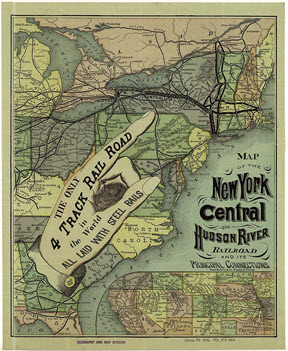 William Dean Howells wrote extensively of his travels in and about European cities such as Venice and London. This quality of observation builds the world of The Parlor Car with travel schedules, railway trivia, boating on the Hudson, fashion and cigars. Trains By 1876, the year The Parlor Car was published, railroads had become America's primary mode of long distance transportation. The play is set on the New York Central Railroad which operated in the Great Lakes and Mid Atlantic regions of the United States. The railroad connected greater New York and Boston in the east with Chicago and St. Louis in the Midwest along with the intermediate cities of Albany, Buffalo, Cleveland, Cincinnati, Detroit, and Syracuse. New York Central was headquartered in New York City's New York Central Building, adjacent to its largest station, Grand Central Terminal. (See map from 1876, right.) In William Dean Howell's play, the train is delayed in Rochester, picks up our romantic couple Syracuse and then strands them somewhere between Utica and Schenectady, on its way to Albany. (See Schenectady Station, left.) The railroad was established in 1853 by Albany industrialist and Railroad owner Erastus Corning, consolidating some of the oldest existing railroad companies in America including the companies referred to in the play:
 "A Pullman
parlor car
offered
respectable
and domestic
amenities to
those able to
pay for them.
The car
interior
resembles a
fine parlor in
a private
home, and no
parlor was
complete
without a
woman to
preside over
it." (From
“Railway
Passenger
Travel,”
Scribner’s
Magazine,
September 1888) "A Pullman
parlor car
offered
respectable
and domestic
amenities to
those able to
pay for them.
The car
interior
resembles a
fine parlor in
a private
home, and no
parlor was
complete
without a
woman to
preside over
it." (From
“Railway
Passenger
Travel,”
Scribner’s
Magazine,
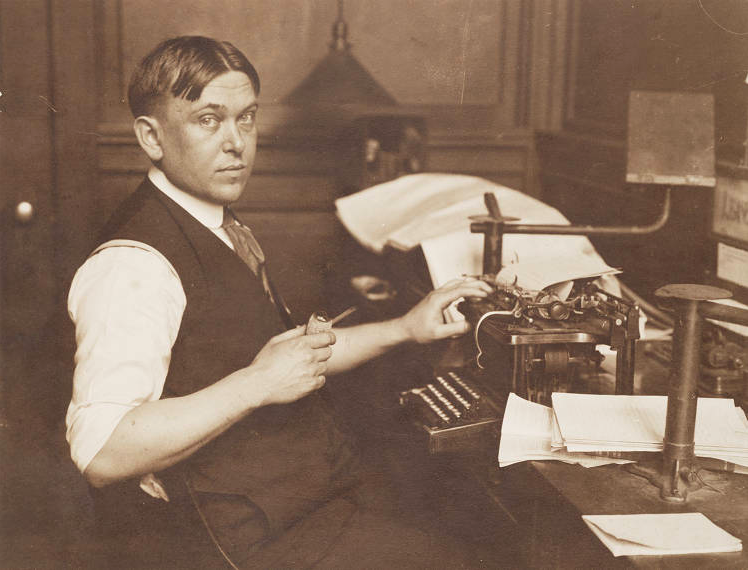
September 1888)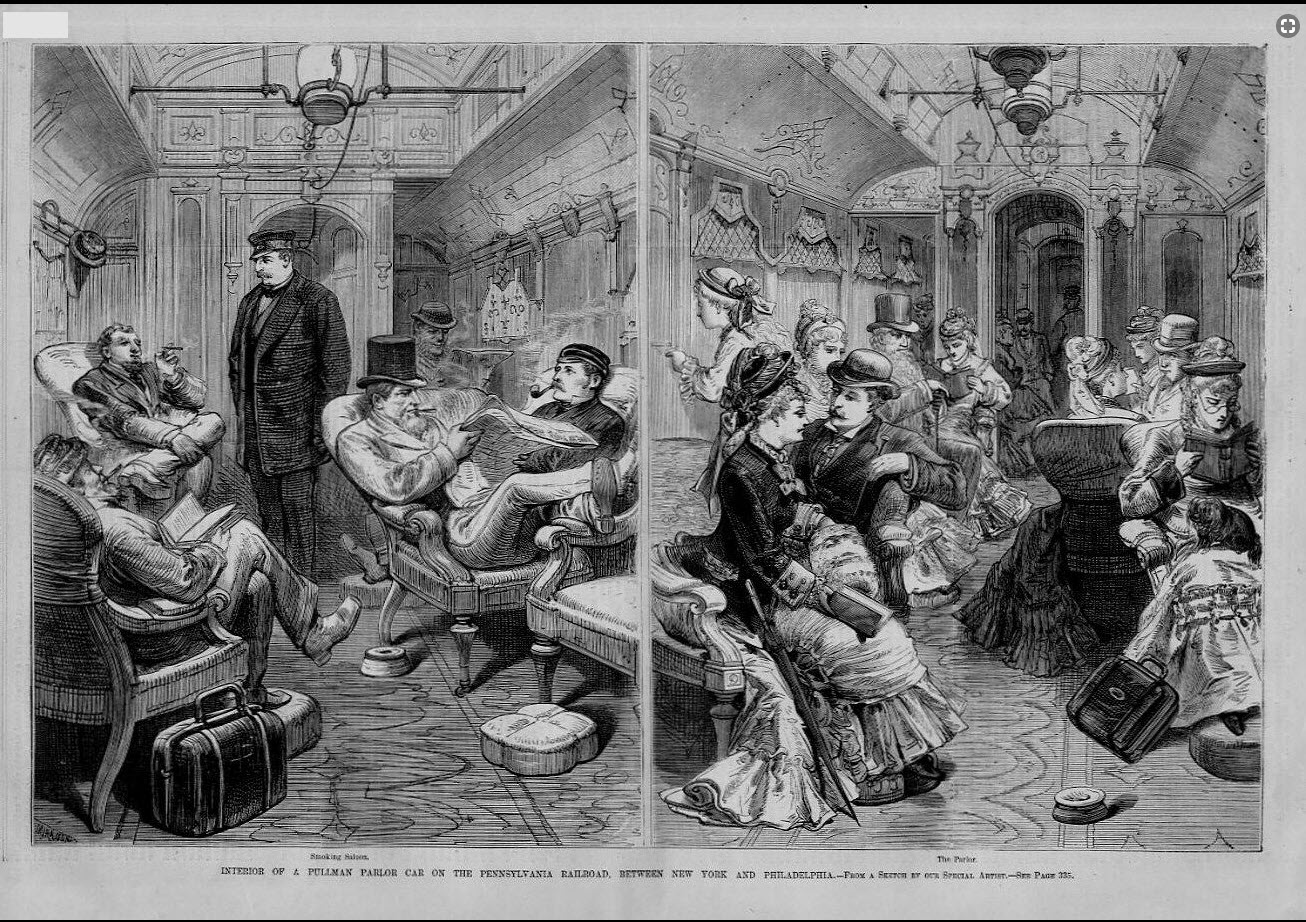 Parlor accommodations were appreciated by those who used
them because
of their
exclusivity.
Journalist H.
L. Mencken
(1880 - 1956,
picture left)
called the
parlor car
"the best
investment
open to an
American":
"He not only
has a certain
seat of his
own, free from
intrusion and
reasonably
roomy; he also
rides in a car
in which all
of the people
are clean and
do not smell
badly. The
stinks in a
day-coach,
even under the
best of
circumstances,
are revolting.
The imbecile
conversation
that goes on in parlor-car
smoke-rooms is
sometimes hard
to bear, but
there is
escape from it
in one's seat;
the gabble in
day-coaches is
worse, and it
is often
accompanied by all sorts of other noises." Parlor accommodations were appreciated by those who used
them because
of their
exclusivity.
Journalist H.
L. Mencken
(1880 - 1956,
picture left)
called the
parlor car
"the best
investment
open to an
American":
"He not only
has a certain
seat of his
own, free from
intrusion and
reasonably
roomy; he also
rides in a car
in which all
of the people
are clean and
do not smell
badly. The
stinks in a
day-coach,
even under the
best of
circumstances,
are revolting.
The imbecile
conversation
that goes on in parlor-car
smoke-rooms is
sometimes hard
to bear, but
there is
escape from it
in one's seat;
the gabble in
day-coaches is
worse, and it
is often
accompanied by all sorts of other noises."Wood-cut to the right engraving is titled "INTERIOR OF A PULLMAN SMOKER and PARLOR CAR ON THE PENNSYLVANIA RAILROAD BETWEEN NEW YORK AND PHILADELPHIA", published in "Frank Leslie's Illustrated" January 1876. This dated engraving from the year of 1876.  A colorful contemporaneous view of the railroads comes from Charles Dickens (1812 - 1870), who with his wife made a first trip to the United States and Canada in 1842. They took a one-day excursion from Boston to the factories of Lowell. His recollections of the trip survive mostly in his travelogue, "American Notes for General Circulation," published later that year. Dickens noticed that the American railroads had no distinct first and second class carriages like their British counterparts. Rather, he remarked that the railroad cars were divided into gentlemen’s cars (where everyone smoked) and ladies’ cars (where no one did). He also noted, nineteenth-century perspective clearly exhibited, that “as a black man never travels with a white one, there is also a negro car”, which he went on to describe as a “great, blundering, clumsy chest”. He found the railroad cars to provide a “great deal of jolting, a great deal of noise, a great deal of wall, not much window, a locomotive engine, a shriek, and a bell”. The cars, he said were like “shabby omnibuses, but larger, holding thirty, forty, or fifty people.” For warmth, the cars were equipped with a stove, he noted, fed with charcoal or anthracite coal, which was red-hot and “insufferably close”. Through the light of its embers, one could see fumes co-mingle with the tendrils of smoke wafting in from the gentlemen’s car. Gentlemen did ride in the ladies’ car, when they accompanied ladies. Also, some ladies travelled alone. Dickens bristled at the informality exhibited by the train conductor (“or check-taker, or guard, or whatever he may be”): “He walks up and down the car, and in and out of it, as his fancy dictates; leans against the door with his hands in his pockets, and stares at you, if you chance to be a stranger; or enters into conversation with the passengers about him.” He also found it odd that “everybody” on the train “talks to you, or to anybody else who hits his fancy.” Dickens noted that politics was much discussed aboard the train, as were banks and cotton. He also noted that, as today, “that directly [after] the acrimony of the last [presidential] election is over, the acrimony of the next one begins”. George Mortimer Pullman and Luxury on the Railroad George Mortimer Pullman (1831-1897) made his name famous as the designer of the eponymous sleeping car, which made its debut in 1865. But sleeping cars had been around since the 1830s - so what made Pullman’s stand out? Comfort. The older 24-person sleeping cars left a lot to be desired and savvy designers leaped at the chance to improve long-distance train travel. George Pullman was a cabinet-maker, engineer, and building-mover. 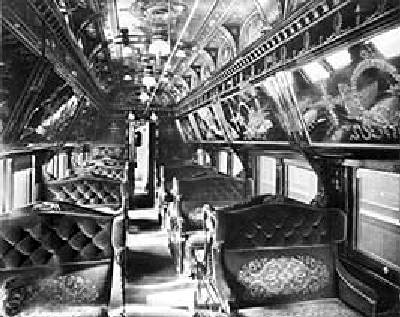 After a particularly uncomfortable train ride, Pullman worked with the Chicago and Alton Railroad Company in 1862 to redesign and remodel their passenger coaches. The Pioneer, as he dubbed his design:
The publicity turned the Pullman sleeping car into an overnight success. And, of course, civilized travel came with a slightly steeper price tag. But in the 19th century, and even into the 20th, long-distance train travel was almost exclusively enjoyed by the wealthy and the growing middle class. And though the Pullman Sleeper required a small additional fare, a berth wasn't unreasonable for people who could afford to travel far enough to need one. As the rail network grew, so did Pullman's empire. He rapidly expanded his enterprise and by 1867, he was running nearly 50 cars on three different railroads. He also developed some new designs: a hotel car, which was basically a Manhattan apartment on wheels, a parlor car, a dining car, and perhaps most importantly, a train vestibule, which made it easy to safely move from one train car to another. Dayboat to Poughkeepsie  The two lovers met on a Dayboat to
Poughkeepsie.The
picture to the
left is the
day boat
disembarkation
in
Pougjkeepsie,
circa
1880.
Many travelers
took the Day
Line boats to
the Catskill
Mountains
region for
summer
vacations
accompanied by
family and
large trunks
of
clothes.
Others took
the boats to
riverside
parks like
Bear Mountain
State Park and
Kingston Point
Park where
they could
spend the day
picnicking and
relaxing, and
then catc h
another
steamer home
again in the
evening.
Many groups from schools, clubs, and other organizations
took yearly
outings on the
Hudson River
Day Line.
The two lovers met on a Dayboat to
Poughkeepsie.The
picture to the
left is the
day boat
disembarkation
in
Pougjkeepsie,
circa
1880.
Many travelers
took the Day
Line boats to
the Catskill
Mountains
region for
summer
vacations
accompanied by
family and
large trunks
of
clothes.
Others took
the boats to
riverside
parks like
Bear Mountain
State Park and
Kingston Point
Park where
they could
spend the day
picnicking and
relaxing, and
then catc h
another
steamer home
again in the
evening.
Many groups from schools, clubs, and other organizations
took yearly
outings on the
Hudson River
Day Line.Whatever the reason f or travel, the Hudson River Day Line provided its passengers with comfort, elegance, and some of the most beautiful scenery in the world at reasonable prices. The Hudson Highlands and West Point were known to travelers from Europe from illustrations in travel books, and a visit to New York was not complete without a trip on the Hudson to see these famous sights. A band or orchestra was always provided on board for pleasant travel, as was a fine restaurant and a cafeteria for less formal meals. Other amenities provided included writing rooms, news-stands, barber shops, and on one steamer, a darkroom for passengers to develop their own photographs en route. The term "floating palaces" aptly described the Hudson River Day Line steamers. Millions of people had happy memories of pleasant summer days on the Hudson River Day Line boats including the Chauncey Vibbard, the Daniel Drew, the Albany, the Hendrick Hudson, the Robert Fulton, the Washington Irving, the Alexander Hamilton, and the Peter Stuyvesant. Hudson River Sloops The hero of T 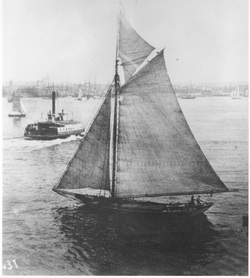 he Parlor Car refers to his "walking
over a slope"
at
night.
The Hudson
River sloop
was the main
means of
transportation
on the Hudson
River from the
early days of
Dutch
settlement in
the 17th
century
(1600s) until
the advent of
the steamboat
as an
affordable
alternative in
the
1820s.
Based on a
Dutch design,
this
single-masted
sailboat
carried
passengers and
cargoes up and
down the
Hudson River
between New
York and
Albany and
points in
between for
over two
hundred
years.
There were
hundreds of
these
vessels.
A trip between
New York and
Albany could
take anywhere
from 24 hours
(a very fast
trip) to
several days,
as speed was
dependent on
wind and
weather
conditions.
Passengers
prepared by
bringing food
and drink to
enhance what
was offered
on
board, and
something to
do with their
time, like
books and
sewing in case
the wind was
light.
Sometimes if
there was no
wind a sloop
would anchor,
and passengers
would go
ashore for a
picnic or a
stroll.
Note the steam
ferry and the
sloop in the
picture to the
left. he Parlor Car refers to his "walking
over a slope"
at
night.
The Hudson
River sloop
was the main
means of
transportation
on the Hudson
River from the
early days of
Dutch
settlement in
the 17th
century
(1600s) until
the advent of
the steamboat
as an
affordable
alternative in
the
1820s.
Based on a
Dutch design,
this
single-masted
sailboat
carried
passengers and
cargoes up and
down the
Hudson River
between New
York and
Albany and
points in
between for
over two
hundred
years.
There were
hundreds of
these
vessels.
A trip between
New York and
Albany could
take anywhere
from 24 hours
(a very fast
trip) to
several days,
as speed was
dependent on
wind and
weather
conditions.
Passengers
prepared by
bringing food
and drink to
enhance what
was offered
on
board, and
something to
do with their
time, like
books and
sewing in case
the wind was
light.
Sometimes if
there was no
wind a sloop
would anchor,
and passengers
would go
ashore for a
picnic or a
stroll.
Note the steam
ferry and the
sloop in the
picture to the
left.Other References Polonaise 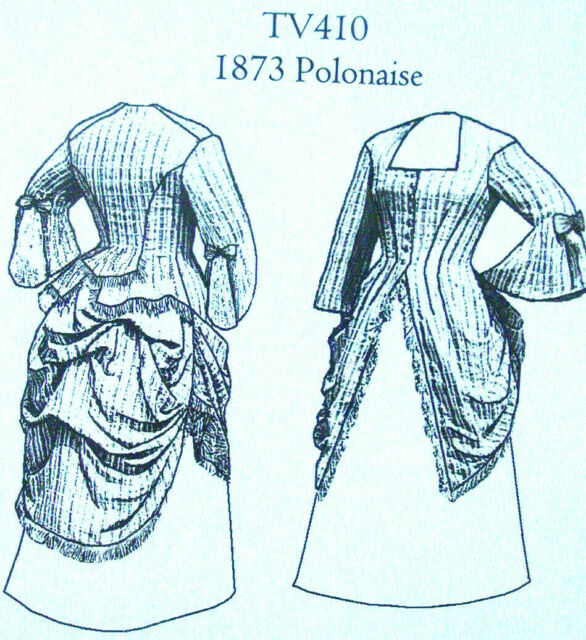 Our heroine's interest in the "polonaise"
suggests that
she is very
much in the
thick of
popular
fashion.
The robe à la
polonaise or
polonaise is a
woman's
garment of the
later 1770s
and 1780s or a
similar
revival style
of the 1870s
inspired by
Polish
national
costume,
consisting of
a gown with a
cutaway,
draped and
swagged
overskirt,
worn over an
underskirt or
petticoat.
From the late
19th century,
the term
polonaise also
described a
fitted
overdress
which extended
into long
panels over
the
underskirt,
but was not
necessarily
draped or
swagged.
The dress
pattern to the
left is from
1873,
contemporaneous
with The
Parlor Car. Our heroine's interest in the "polonaise"
suggests that
she is very
much in the
thick of
popular
fashion.
The robe à la
polonaise or
polonaise is a
woman's
garment of the
later 1770s
and 1780s or a
similar
revival style
of the 1870s
inspired by
Polish
national
costume,
consisting of
a gown with a
cutaway,
draped and
swagged
overskirt,
worn over an
underskirt or
petticoat.
From the late
19th century,
the term
polonaise also
described a
fitted
overdress
which extended
into long
panels over
the
underskirt,
but was not
necessarily
draped or
swagged.
The dress
pattern to the
left is from
1873,
contemporaneous
with The
Parlor Car.
Embroidered Cigar Cases 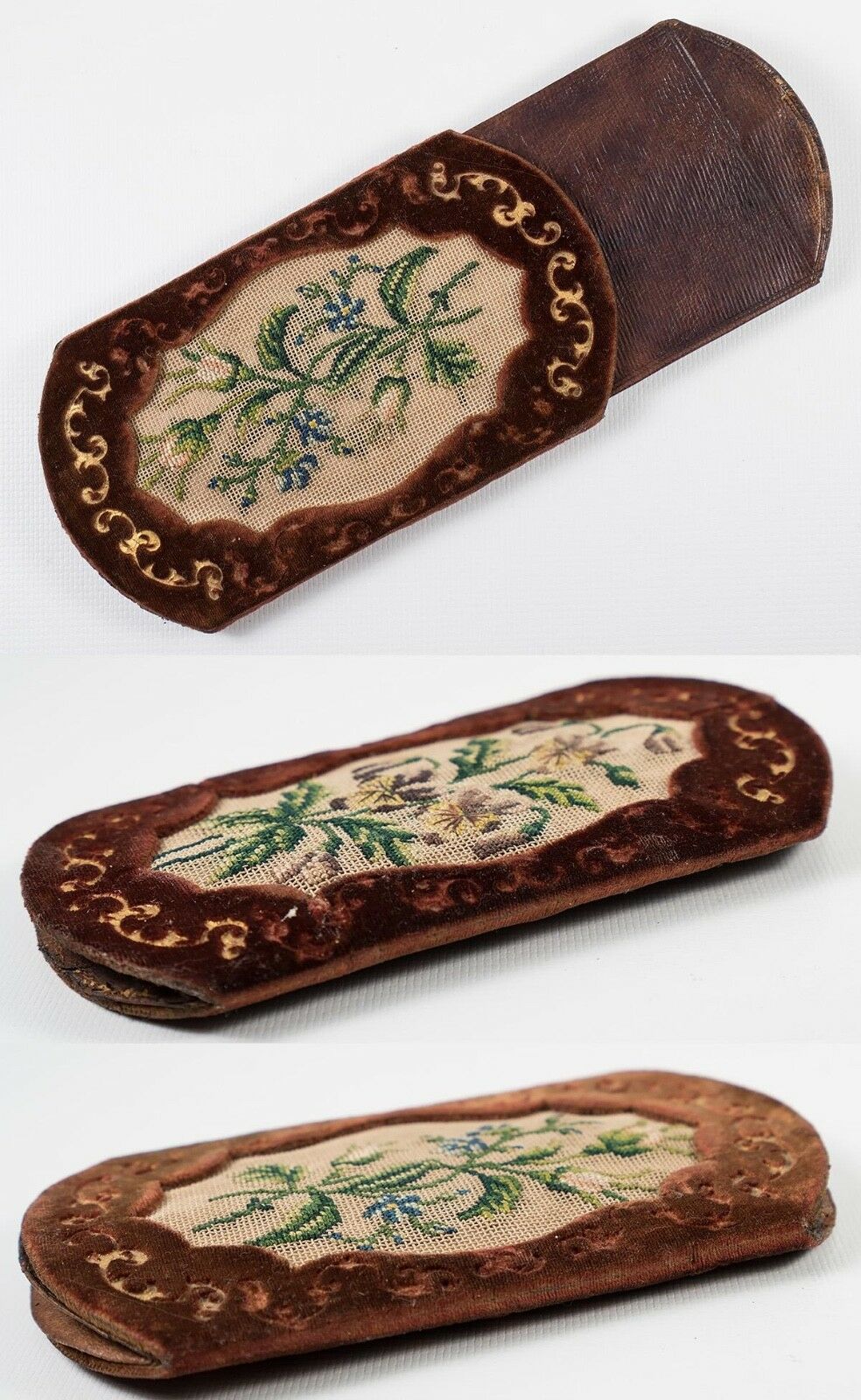 Cigars and their accoutrement were very much
a part of 19th
century life.
By the middle
of the
nineteenth
century,
smoking cigars
had become so
universal as
to require: Cigars and their accoutrement were very much
a part of 19th
century life.
By the middle
of the
nineteenth
century,
smoking cigars
had become so
universal as
to require:The cigar became a status symbol in the United States, in part, because of its use by such well-respected figures as President Ulysses S. Grant and the writer Mark Twain (Samuel Clemens, a good friend of William Dean Howells). Twain expressed his love of tobacco and cigars often in speeches and in his non-fiction. In his Following the Equator (1897), the author writes "I pledged myself to smoke but one cigar a day. I kept the cigar waiting until bedtime, then I had a luxurious time with it. But desire persecuted me every day and all day long; so, within the week I found myself hunting for larger cigars than I had been used to smoke; then larger ones still, and still larger ones." The famous Henry Clay cigar, named after the American senator, was launched toward the end of the nineteenth century as a premium cigar product. By the end of the nineteenth century there were more than 7,000 cigar factories in the United States, with some 500 located in the state of Florida. The Parlor Car, First Publication 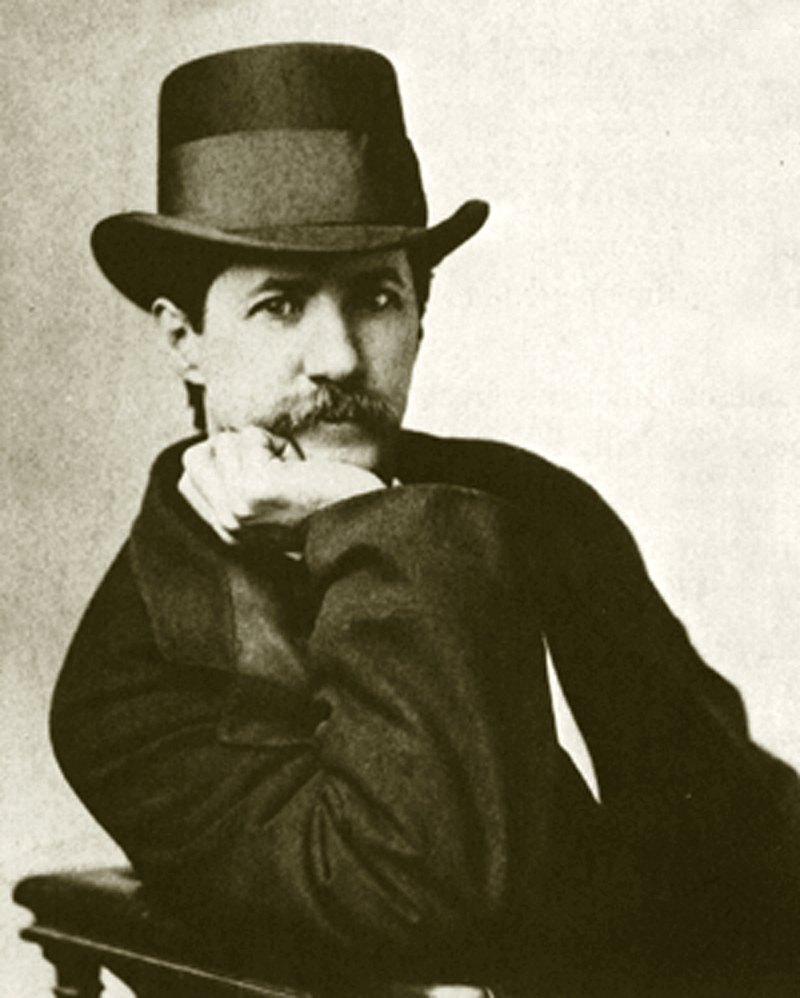 Augustin
Daly (1838 –
1899) Augustin
Daly (1838 –
1899)It starts with John Augustin Daly, playwright and for three decades one of America's foremost theatrical producers and managers. Among other contributions, Daly encouraged  American
playwrights by
producing
their plays
and calling in
print and
correspondence
for even
better plays.
He also
encouraged
contemporary
literary
figures such
as Bret Harte,
Mark Twain,
William Dean
Howells, and
Henry James to
write plays
for
production.
When his
company took
over the Fifth
Avenue
Theatre, in
1874, Daly
sent a request
to Samuel
Clemens for a
new play Daly
might produce.
Clemens
declined: American
playwrights by
producing
their plays
and calling in
print and
correspondence
for even
better plays.
He also
encouraged
contemporary
literary
figures such
as Bret Harte,
Mark Twain,
William Dean
Howells, and
Henry James to
write plays
for
production.
When his
company took
over the Fifth
Avenue
Theatre, in
1874, Daly
sent a request
to Samuel
Clemens for a
new play Daly
might produce.
Clemens
declined: Samuel Clemens (1835 - 1910) My dear Mr. Daly, Oct. 29. Although I am not able to write a play now, there are better men that can. Would it not be well worth your while to provoke W. D. Howells of the Atlantic Monthly into writing a play? My reason for making the suggestion is that I think he is writing a play. I by no means know this, but I guess it from a remark dropped by an acquaintance of his. I know Howells well, but he has not confided anything of the kind to me. Still, I think if you and Bronson are done with your fight (I mean the newspaper one) it would be a right good thing to hurl another candidate into the jaws of the critics. I am not meaning to intrude & hope I am not. Yrs. truly, Sam L. Clemens Mr. Daly did venture in accordance with Mark Twain's (see picture of Howells and Clemens) suggestion gently to "provoke" Mr. Howells into writing a play, and received the following : Cambridge, Mass. Nov. 14, 1874. My dear Sir: — Do not suppose from the great 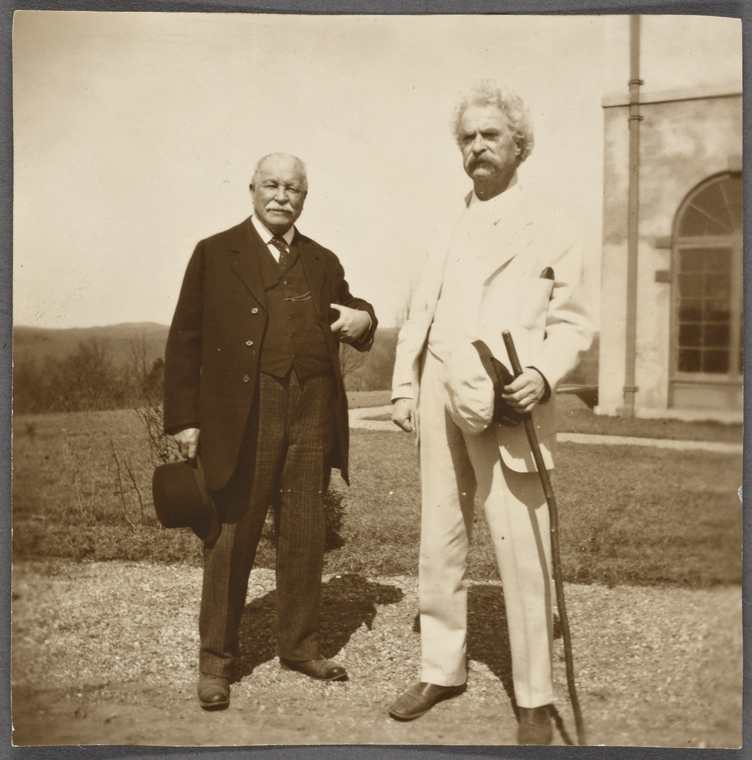 deliberation
with which I
answer your
obliging
letter that I
was not very
glad indeed to
get it. I have
long had the
notion of a
play, which I
have now
briefly
exposed to Mr.
Clemens, and
which he
thinks will
do. It's
against it, I
suppose, that
it's rather
tragical, but
perhaps —
certainly if
you've ever
troubled
yourself with
my undramatic
writings, —
you know that
I can't deal
exclusively in
tragedy, and I
think I could
make my play
in some parts
such a light
affair that
many people
would never
know how
deeply they
ought to have
been moved by
it.
deliberation
with which I
answer your
obliging
letter that I
was not very
glad indeed to
get it. I have
long had the
notion of a
play, which I
have now
briefly
exposed to Mr.
Clemens, and
which he
thinks will
do. It's
against it, I
suppose, that
it's rather
tragical, but
perhaps —
certainly if
you've ever
troubled
yourself with
my undramatic
writings, —
you know that
I can't deal
exclusively in
tragedy, and I
think I could
make my play
in some parts
such a light
affair that
many people
would never
know how
deeply they
ought to have
been moved by
it. I have also the idea of a farce or vaudeville of strictly American circumstances. Of course I'm a very busy man, and I must do these plays in moments of leisure from my editorial work. I'm well aware that I can't write a good play by inspiration, and when I've sketched my plots and done some scenes I shall, with your leave, send them for your criticism. Yours very truly, W. D. Howells.  The
requirements
of the past
season had
prevented
Augustin from
staging Mr. W.
D. Howells'
first play,
which had been
announced for
as early as
August, 1876
(for the Fifth
Avenue, see
picture left): The
requirements
of the past
season had
prevented
Augustin from
staging Mr. W.
D. Howells'
first play,
which had been
announced for
as early as
August, 1876
(for the Fifth
Avenue, see
picture left):"A new comedietta, The Parlor Car, which has been accepted by Mr. Daly, is to be published in The Atlantic Monthly, the author preferring to have the piece criticised in advance." It will be recalled that it was at Mark Twain's suggestion that Mr. Daly proposed to the editor of The Atlantic Monthly an excursion into the dramatic field, with the result now told in these letters : "Editorial office of The Atlantic Monthly, The Riverside Press, Cambridge, Mass. April 24, 1876  My dear
Sir: You have
doubtless
forgotten a
very kind
invitation you
gave me
something more
than a year
since to send
you anything I
might write in
the way of a
play ; and
it's with no
purpose of
trying to
create a sense
of obligation
in you that I
recall a fact
so gratifying
to myself. My dear
Sir: You have
doubtless
forgotten a
very kind
invitation you
gave me
something more
than a year
since to send
you anything I
might write in
the way of a
play ; and
it's with no
purpose of
trying to
create a sense
of obligation
in you that I
recall a fact
so gratifying
to myself. Here is a little comedy which I have pleased myself in writing. It was meant to be printed in The Atlantic, (and so the stage direction, for the reader's intelligence, was made very full) ; but I read it to an actor the other day, and he said it would play; I myself had fancied that a drawing-room car on the stage would be a pretty novelty, and that some amusing effects could be produced by an imitation of the motion of a train, and the collision. However, here is the thing. I feel so diffident about it, that I have scarcely the courage to ask you to read it. But if you will do so, I shall be very glad. If by any chance it should please you, and you should feel like bringing it out on some off-night when nobody will be there, pray tell me whether it will hurt or help it, for your purpose, to be published in The Atlantic. Yours trulv W. D. Howells. Mr. Howells received comments from Mr. Daly and sends rewrites and suggests that Mr. Daly may be less than enthusiastic as regards the prospect of the performance of the piece at his Fifth Avenue Theatre. (See poster to the left.) Editorial office of The Atlantic Monthly. The Riverside Press, Cambridge, Mass. May 9, 1876. My dear Mr. Daly: I am very much gratified that you like my little farce, though your kindness makes me feel its slightness all the more keenly. If you think it will play, it is at your disposal; I could not imagine a better fortune for it than you suggest ; and if it fails, I shall have the satisfaction — melancholy but entirely definite — of knowing that it was my fault. I suppose that even if my Parlor Car meets with an accident it need not telescope any future dramatic attempt of mine ? I confide in your judgment and experience; and I am going to send you some half dozen pa  ges more
of this size,
supplying some
further shades
of character
in the lady's
case, and
heightening
the effect of
the
catastrophe.
Very truly
yours , W. D.
Howells. ges more
of this size,
supplying some
further shades
of character
in the lady's
case, and
heightening
the effect of
the
catastrophe.
Very truly
yours , W. D.
Howells. A clipping from the Boston Globe, July 24, 1876, announcing the delay of the production and the upcoming publication in the Altlantic Monthly.  While
The Parlor
Car was
waiting to be
attached to
the first
available
train, the
author was
employing his
spare hours in
a dramatic
work of more
dignity : a
comedy in four
acts which was
also to be
submitted to
the manager of
the Fifth
Avenue
Theatre. (See
poster to the
left.)
It was
completed in
due time and
read, but, not
at all to the
author's
disappointment
(for he said
he had little
hopes of its
"theatricability"),
it was found
wanting. While
The Parlor
Car was
waiting to be
attached to
the first
available
train, the
author was
employing his
spare hours in
a dramatic
work of more
dignity : a
comedy in four
acts which was
also to be
submitted to
the manager of
the Fifth
Avenue
Theatre. (See
poster to the
left.)
It was
completed in
due time and
read, but, not
at all to the
author's
disappointment
(for he said
he had little
hopes of its
"theatricability"),
it was found
wanting.The Parlor Car was never produced by Augustin Daly, though it was published first in The Atlantic Monthly in 1876 and later in various collections of Howells' play and of American one-acts. |
|
William Dean
Howells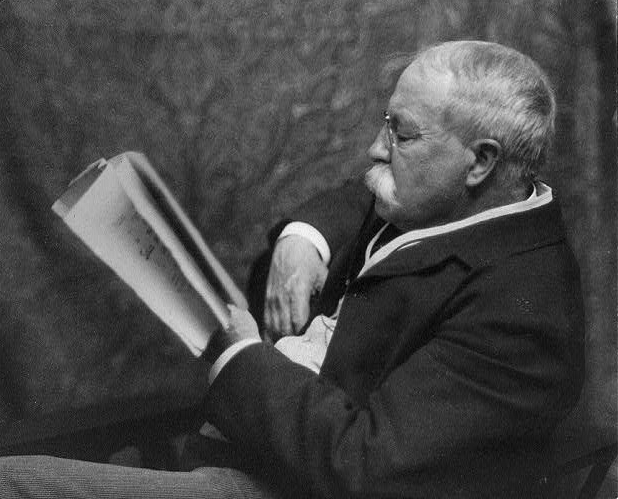 William Dean HowellsWilliam Dean Howells (1837-1920), author, editor, and critic, was born on 1 March 1837 in Martinsville, now Martins Ferry, Ohio, the second son of eight children born to Mary Dean Howells and William Cooper Howells, a printer and publisher. As the family moved from town to town, including a year-long residence at a utopian commune in Eureka Mills, later described in his New Leaf Mills (1913), Howells worked as a typesetter and a printer's apprentice, educating himself through intensive reading and the study of Spanish, French, Latin, and German. After a term as city editor of the Ohio State Journal in 1858, Howells published poems, stories, and reviews in the Atlantic Monthly and other magazines. A longer work, his campaign biography for Abraham Lincoln, earned him enough money to travel to New England and meet the great literary figures of the day-Nathaniel Hawthorne, Ralph Waldo Emerson, Henry David Thoreau, James Russell Lowell, and Walt Whitman among them. Awarded the post of U. S. Consul to Venice in 1861 for his service to the Lincoln campaign, Howells lived in Italy for nearly four years. During his residence there, he married Elinor Mead Howells in 1862, and by 1872 the couple had three children: Winifred (b. 1863), John Mead (b. 1868), and Mildred (b. 1872). After leaving Venice, Howells became first the assistant editor (1866-71) and then the editor (1871-1881) of the Atlantic Monthly, a post that gave him enormous influence as an arbiter of American taste. Publishing work by authors such as Mark Twain and Henry James, both of whom would become personal friends, Howells became a proponent of American realism, and his defense of Henry James in an article for The Century (1882) provoked what was called the "Realism War," with writers on both sides of the Atlantic ocean debating the merits of realistic and romantic fiction. While writing the "Editor's Study" (1886-1892) and "Editor's Easy Chair" (1899-1909) for Harper's New Monthly Magazine and occasional pieces for The North American Review, Howells championed the work of many writers, including Emily Dickinson, Mary E. Wilkins Freeman, Hamlin Garland, Sarah Orne Jewett, Charles W. C 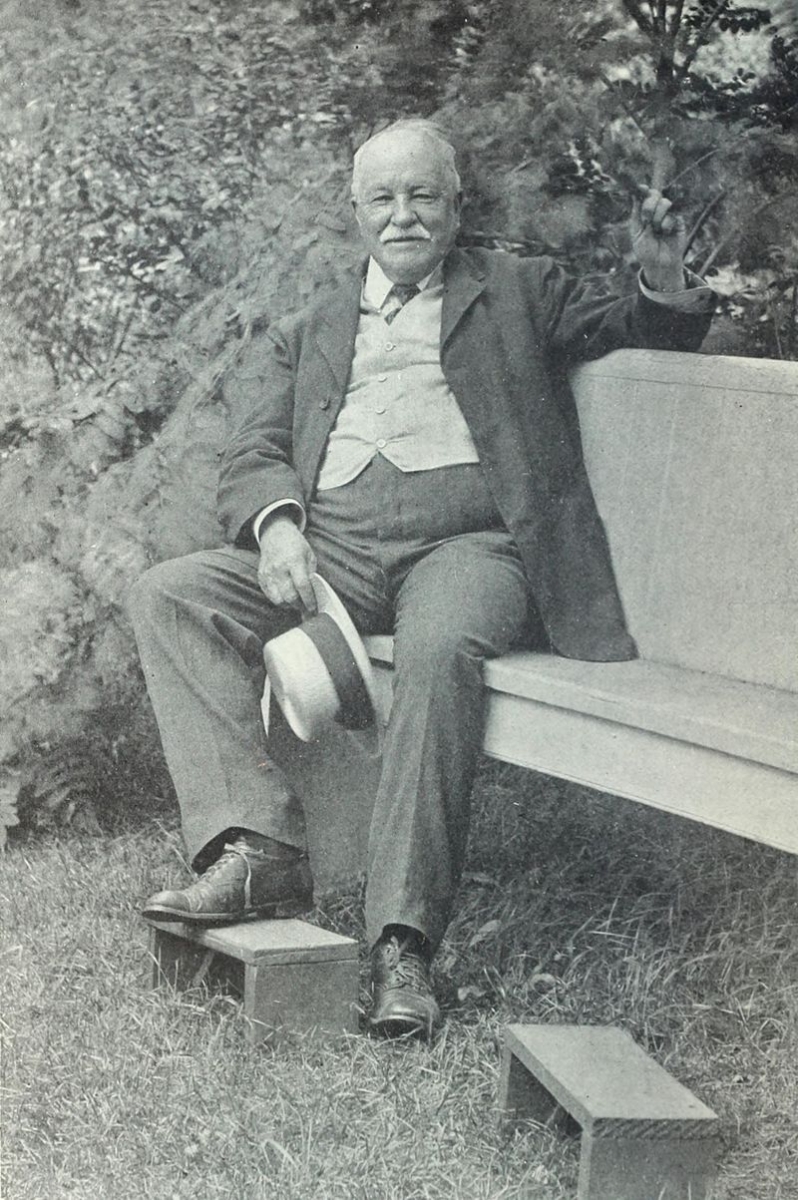 hesnutt,
Frank Norris, Paul Laurence Dunbar, Abraham Cahan, and
Stephen Crane. He was also responsible for promoting
such European authors as Ibsen, Zola, Pérez Galdós,
Verga, and Tolstoy. Despite Howells's professional
success, his personal life during this period was marred
in 1889 by the premature death of his daughter Winifred,
whose physical symptoms were misdiagnosed as resulting
from a nervous disorder and were ineffectively treated. hesnutt,
Frank Norris, Paul Laurence Dunbar, Abraham Cahan, and
Stephen Crane. He was also responsible for promoting
such European authors as Ibsen, Zola, Pérez Galdós,
Verga, and Tolstoy. Despite Howells's professional
success, his personal life during this period was marred
in 1889 by the premature death of his daughter Winifred,
whose physical symptoms were misdiagnosed as resulting
from a nervous disorder and were ineffectively treated.
After the execution of the Haymarket radicals in 1887, which he risked his reputation to protest, Howells became increasingly concerned with social issues, as seen in stories such as "Editha" (1905) and novels concerned with race (An Imperative Duty, 1892), the problems of labor (Annie Kilburn, 1888), and professions for women (The Coast of Bohemia, 1893). Although he wrote over a hundred books in various genres, including novels, poems, literary criticism, plays, memoirs, and travel narratives, Howells is best known today for his realistic fiction, including A Modern Instance (1881), on the then-new topic of the social consequences of divorce; The Rise of Silas Lapham (1885), his best-known work and one of the first novels to study the American businessman; and A Hazard of New Fortunes (1890), an exploration of cosmopolitan life in New York City as seen through the eyes of Basil and Isabel March, the protagonists of Their Wedding Journey (1871) and other works. Other important novels include Dr. Breen's Practice, (1880), The Minister's Charge and Indian Summer (1886), April Hopes (1887), The Landlord at Lion's Head (1897), and The Son of Royal Langbrith (1904). |
 |
 |
|